
What Did Njohi Really Mean in Agĩkũyũ Marriage?

The gourd was never the marriage. It was part of the language of the marriage
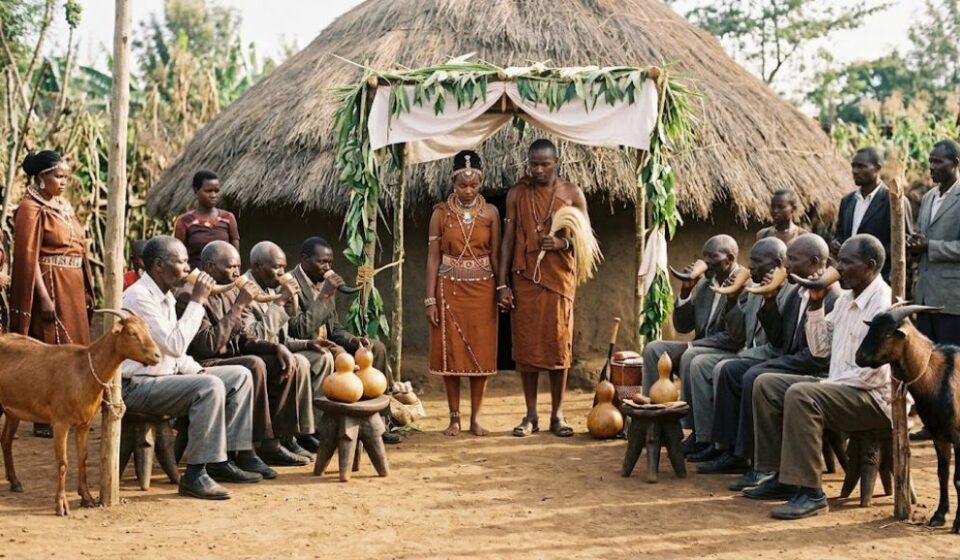
When we look back at Agĩkũyũ marriage today, one thing often catches our attention before everything else: njohi, the traditional brew shared during different stages of the marriage process. To a modern eye, it can easily look as if the ceremony was simply an occasion for people to drink. But was that really the point?
Njohi was never merely a drink. It carried meaning, and the purpose for which it was brewed mattered. This is why different njohi had different names, known in Gĩkũyũ as ritwa ria gitumi kiayo—the name that identified its purpose.
For the Agĩkũyũ, njohi could symbolise communion with ancestors, the unity of the people and reverence for life. It featured in important occasions such as naming ceremonies, initiation, marriage, reconciliation and other gatherings. Each occasion had its own purpose, and njohi formed part of the language through which that purpose was expressed.
Our ancestors did not simply gather, drink and go home. Who was present mattered. Why the njohi had been prepared mattered. Who was entitled to drink mattered. And what was said before, during and after the drinking mattered. The drink was visible, but the meaning was deeper than the drink.
Was njohi simply traditional beer, or did it have a sacred meaning?
I believe we need to recover this distinction. Njohi could accompany worship, sacrifice, thanksgiving and other important communal activities. It could also be used in marriage negotiations, hospitality and reconciliation. These were different institutions, and we should not reduce them all to drinking parties simply because a fermented drink was involved.
Consider a naming ceremony. People assembled around a child and the responsibilities of kinship. At a peace-making gathering, the concern was a broken relationship. At a marriage sitting, it was the gradual building of a bond between two families. The drink had a place in these proceedings, but it was not the purpose of the proceedings.
Jomo Kenyatta, in Facing Mount Kenya, describes a sacrificial ceremony at a sacred tree during which elders sprinkled milk and honey beer. Katherine and W. Scoresby Routledge also recorded prayers and the sharing of njohi following a sacrifice to Ngai. Although historical accounts must be read with an awareness of their authors’ perspectives, they help us understand that njohi could form part of a religious act.
This does not mean that Agĩkũyũ worship was the same as Christian Holy Communion. The beliefs and meanings were different. The comparison simply helps us ask a fair question: if a fermented drink can have a place in a religious ceremony, why should the presence of a similar drink in an African ceremony automatically be treated as evidence of sin?
Were honey beer and sugarcane beer used for the same occasions?
Even the type of njohi served could communicate something about the occasion. Honey beer, known in English as mead, held a special ceremonial position in the customary practice described here. It was associated with religious observances, receiving in-laws and honouring people to whom particular respect was due. Sugarcane-based beer, on the other hand, could be used more routinely for hospitality.
For example, a visitor arriving at a thingira (the men’s hut where guests were received), might be offered sugarcane brew as part of ordinary hospitality. Receiving someone in this way was not necessarily the same as preparing a special ceremonial drink for an important occasion. The distinction was not simply about the ingredients or alcohol content. It was about the occasion, the people involved and the relationship being recognised.
George Kuria Kiarie’s research, drawing on earlier ethnographic accounts, also discusses distinctions between honey beer used for special occasions and sugarcane brew associated with hospitality. Such practices could vary between localities, so we should not assume that every Agĩkũyũ community followed precisely the same arrangement. The important lesson is that two drinks could look similar in the gourd but serve different social purposes
Why was njohi used in blessings and reconciliation?
One example is the well-known blessing of gũtuĩra mata gĩthũri, performed after taking a sip of njohi. This was not simply a drinking gesture. It was a blessing invoked over matters that required blessing, whether within the home or at a wider cultural gathering.
In the marriage process, njohi could accompany prayers, sacrifices, blessings and other significant moments. During horohio, the process of reconciliation, it could form part of restoring harmony between people. A person who had offended others and brought disgrace upon themselves could, where the offence permitted reconciliation, seek to make amends through mbũri na njohi ya horohio (a goat or sheep together with njohi) offered in a process intended to cool anger and restore relationships. This was not a solution for every offence, nor should we assume that every wrong could be settled in this way. The important point is that the drink could form part of a wider process of acknowledging wrongdoing and rebuilding relationships.
Kenyatta also describes a son seeking his father’s forgiveness through the presentation of a sheep or he-goat and beer, followed by the father’s blessing. The details of that account need not be identical to every local practice for us to recognise the broader role that animals, drinks and blessings could play in making amends. Here is a question worth considering: if njohi were evil simply because it contained alcohol, how did it come to have a place in restoring peace between people? To understand the practice, we must first understand what the community was trying to accomplish.
Did everybody have the right to drink njohi?
No. Traditionally, participation could be governed by age, family standing and social responsibility. Not everyone was entitled to drink ceremonial njohi simply because it was available.
Among those recognised as having the appropriate standing were athuri (older men), and nyakĩnyua, (women who had attained a particular status associated with the marriage of their children).
The stages of a woman’s social standing are especially important here. In the customary framework described in my writing, nyakang’ei referred to a newly married woman. Nyakaregeri described a later stage associated with having a child who had undergone initiation. Neither status, by itself, brought the entitlement associated with nyakĩnyua.
That later status was connected to the marriage of her child. The expression nĩ anyuĩte njohi ya mwana meant that she had drunk the njohi associated with her child’s marriage. This helps explain why the role of a woman in the marriage process was not determined by age alone. Her place in the family and the milestones she had reached also mattered.
Some restrictions were mĩgiro, or customary prohibitions governing who could do what and when. Such rules formed part of the social framework within which ceremonial njohi was shared.
Today, practices may differ. Younger women, for example, may drink njohi during celebrations associated with the initiation of their sons. We should not automatically assume that every modern practice reflects the older customary rules. The traditional system was not simply about who wanted to drink. It was also about who had attained the standing to participate.
Was njohi meant to make people drunk?
No. Ceremonial njohi was about participation, blessing and recognition, not intoxication. The expression “Njohi ya igongona nĩ njũno” captures an important principle: sacred njohi was to be tasted as part of the ceremony, not consumed excessively. The sip had meaning because of the occasion in which it was taken. In sacred njohi, the meaning was in the sip, not in the amount. The distinction is important because we sometimes confuse the presence of alcohol with the abuse of alcohol. A ceremonial sip and drunkenness are not the same thing.
Katherine and W. Scoresby Routledge recorded restrictions on who could drink, alongside observations of occasional intoxication. We should acknowledge this evidence rather than portray the past as perfect. However, an account of occasional excess does not tell us how widespread alcohol dependence was, just as the absence of frequent descriptions of it cannot prove that it never existed.
The more careful conclusion is that customary life included rules governing participation, different uses of njohi and social expectations about conduct. We should preserve what the evidence supports without inventing an idealised past.
Why did every njohi in the marriage process have a name?
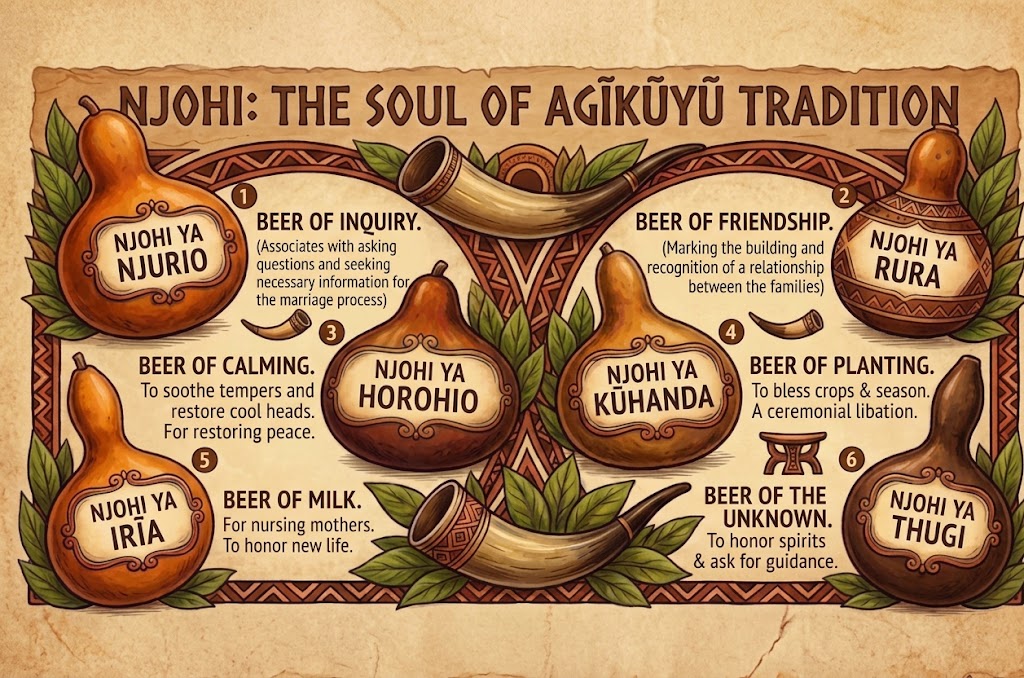
This is where the richness of Agĩkũyũ marriage becomes especially interesting. Agĩkũyũ marriage was not a one-day event. As I explain in my book Ũthoni wa Ũgĩkũyũ na Ũrũngi wa Icũrĩ (Kikuyu Marriage & Rectification), it involved a sequence of sittings, each with its own purpose. The name of the njohi helped communicate the business of the sitting. It told the participants why the families had gathered and what stage of the relationship they were considering.
The first four sittings illustrate this well. The first, njohi ya mwanake kũhe ithe ũhoro wa mũirĩtu, accompanied the young man informing his father that he had identified a young woman he wished to marry. The second, njohi ya rũra, marked the beginning of friendship with the prospective in-laws. The third, njohi ya kũheana kĩhĩĩ, was associated with presenting the young man to his prospective father-in-law. The fourth, njohi ya njũrio, marked a more formal stage in which the marriage request was presented for inquiry and consideration.
These were not simply four occasions for people to drink. They were steps in a process through which a relationship was introduced, examined and gradually developed. Other njohi had their own purposes. Njohi ya kũhe ithe ũhoro wa woni wa mũirĩtu ũrĩa arenda kũhikia referred to informing the girl’s father about the young man or family seeking to marry his daughter. Njohi ya Rura marked friendship between the families, while njohi ya Kumagaria ũhiũ rwa rũracio was associated with symbolically escorting and blessing the bride wealth. These names tell us something easily missed when we simply translate njohi as “beer.” The name told you why the families were meeting. The sitting told you what they needed to accomplish.
The sixteen sittings, or cikaro, were not sixteen invitations to drink for drinking’s sake. Each had a place within the wider process. The njohi accompanied that process; it did not replace the discussions, decisions and responsibilities that made the marriage possible. The gourd carried the drink, but the sitting carried the agreement.
Did everyone have to drink when the rũhia reached them?
Not even traditionally. Someone could be unwell, have an upset stomach or simply be unable to take njohi on that particular day. The person could pass the rũhia (the drinking vessel), to another person and say: “Ngundĩra, ndirĩhota nayo ũmũthĩ.” (Drink this for me; today I am not able). The ceremony did not have to stop.
An Agĩkũyũ saying captures this beautifully: “Njanja ĩmwe ndĩtĩragia itega.” (One broken gourd on the journey does not prevent the others from delivering what they carry). In other words, one person’s inability to participate in a particular way did not have to prevent the wider purpose from being achieved. You could pass the gourd without passing out of the ceremony. This is a useful lesson for today’s families, especially where people hold different religious convictions or have personal reasons for avoiding alcohol.
What happened when njohi encountered Christianity?
This is where the discussion becomes more complicated. Christianity has profoundly influenced Agĩkũyũ society, and Christians themselves do not all hold the same view about alcohol. The Catholic tradition uses wine in the Eucharist, while some Protestant churches have historically promoted complete abstinence.
Yet the Bible presents a more nuanced picture than the claim that all alcohol is forbidden. Ephesians 5:18 warns against drunkenness. In 1 Timothy 5:23, Paul advises Timothy to take a little wine. Wine also appears in the Gospel accounts of the Last Supper, while John 2:1–11 recounts the wedding at Cana. These passages need to be understood in their proper contexts, but they remind us that the biblical discussion involves more than the mere presence of alcohol.
The question, therefore, is not whether every Christian must drink njohi. The question is whether the drink’s presence in an African cultural setting should automatically be treated as evidence that the entire ceremony is sinful.
European grape wine and Agĩkũyũ njohi differ in ingredients, flavour, preparation and alcohol concentration. Yet fermented grape wine, honey mead and sugarcane beer all contain ethanol. Chemically, ethanol remains ethanol regardless of whether it is served in a European glass or an Agĩkũyũ rũhia. The molecule did not change its identity when it crossed a cultural boundary.
This is not an argument that all fermented drinks can be substituted for grape wine in Holy Communion. Churches may have specific theological and liturgical rules governing the elements used in their sacraments. Nor does it mean that Christian worship and Agĩkũyũ worship are the same.The question is a narrower one: why might a drink be treated with reverence in one cultural setting while a comparable drink becomes a mark of moral inferiority in another? A rule governing the composition of Communion wine is one thing. A judgment condemning an entire African culture because its people used a fermented drink is another.
George Kuria Kiarie’s research on the Anglican Diocese of Thika documents tensions surrounding church wine and locally brewed drinks, including the belief among some Christians that indigenous brews were unholy.
Missionaries and churches were not all of one mind, and Christianity’s history in Kenya cannot be reduced to condemnation of African culture. Nevertheless, there were occasions when European cultural judgments became closely attached to Christian instruction. Over time, some Africans came to accept those judgments as if they were direct commandments from God. This is where Ngũgĩ wa Thiong’o’s call to decolonise the mind becomes relevant. We need to examine inherited judgments rather than accept them automatically.
Acts 15:19–29 is instructive. The apostles and elders in Jerusalem considered what burdens should be placed upon Gentiles entering the Christian community. Their decision did not make Jewish cultural identity a general condition for belonging to the faith. Njohi was not under discussion at the Council of Jerusalem. The lesson I draw from the passage is broader: we should distinguish the requirements of a faith from cultural expectations attached to its messengers. Before condemning an African institution, find out what it was for.
Must a Christian drink njohi to honour the tradition?
I do not believe so. A Christian who has a conviction against drinking should not be forced to drink simply because the rũhia has reached them. They can respectfully decline, use a non-alcoholic alternative or pass their share to somebody else. What matters is that we do not confuse drinking njohi with honouring the marriage.
A person can decline alcohol and still respect the families. They can hold a Christian conviction and still appreciate the cultural meaning of the occasion. The same principle applies to families seeking to preserve their traditions while respecting the beliefs of their members. The disagreement over alcohol should not become bigger than the relationship the families have gathered to celebrate.
What changed when brewing became part of the cash economy?
To understand the changing place of alcohol in Agĩkũyũ society, we must also consider economic history. Colonial economic changes altered how people produced, exchanged and consumed goods. Land alienation, wage employment and the growth of towns drew people away from some older household arrangements and increased the importance of money in everyday life.
Alcohol became part of this wider cash economy. Trade existed before colonialism, so it would be misleading to suggest that commercial exchange began with colonial rule. What changed was the scale and organisation of markets in which a person could buy beer without any connection to the occasion for which it had originally been brewed.
Research on Nairobi between 1920 and 1939 documents African women brewing beer for sale as a source of income, while colonial officials attempted to regulate the trade and municipal beer halls changed the conditions under which alcohol was supplied. These women were also responding to economic circumstances. Their work belongs in the story alongside the actions of licensing authorities and commercial breweries.
Consider the difference between two situations. In the first, a family prepares njohi for the arrival of in-laws, a reconciliation gathering or a religious observance. The occasion gives the drink a defined purpose, and the people involved understand the responsibilities attached to it. In the second, a trader sells beer for cash. The buyer can return to purchase more without any marriage negotiation, initiation or reconciliation to justify the gathering.
Neither situation automatically makes everyone involved responsible or irresponsible. The difference lies in the incentives and the social relationships surrounding the drink.When alcohol became easier to separate from the occasion, it also became easier to separate from some of the responsibilities that once governed its use.
This helps us understand how social rules and economic incentives can change. It does not prove that commercialisation alone caused modern alcohol problems, but it offers a useful historical question to investigate.
What should we learn from today’s alcohol problems?
Kenya faces serious problems associated with harmful drinking, alcohol dependence and unsafe or adulterated products. NACADA’s National Survey on the Status of Drugs and Substance Use in Kenya 2022 provides a source for understanding the wider substance-use challenge.https://nacada.go.ke/sites/default/files/2023-05/Abridged%20Version_National%20Survey%20on%20the%20Status%20of%20Drugs%20and%20Substance%20Use%20in%20Kenya%202022.pdf
These problems deserve attention in their own right. Poverty, unemployment, availability, marketing, law enforcement, family circumstances and individual choices can all form part of the picture. It would be careless history to attribute the modern crisis to a single colonial change. Equally, it would be careless theology to conclude that the earlier ceremonial use of njohi was responsible for the crisis.
We should neither romanticise the past nor ignore the harm alcohol can cause today. Our ancestors had customs and restrictions, but that does not establish that alcohol dependence was unknown. Modern commercial markets have their own pressures, but not every commercial brewer is irresponsible, and not every traditional gathering was free of excess. The task is to understand the evidence, recognise the differences between historical settings and address harmful drinking without condemning an entire culture.
If the objection is to drunkenness, then the standard should apply consistently to all drinks and all people. If the objection concerns a specific religious practice, then we should examine that practice and explain the objection clearly. We can oppose the abuse of alcohol without treating every cultural use of it as an abuse.
What can today’s Agĩkũyũ learn from the old practice?
Perhaps the greatest lesson is that culture was more structured than we sometimes imagine. Our ancestors did not simply prepare beer and let everyone drink. Different njohi could have different names and purposes. Social standing influenced who could participate. The occasion determined what was expected of the people gathered. The drink formed part of a wider network of relationships, responsibilities and shared understanding.
Today, some of that structure has weakened. We may retain the drink while forgetting its purpose. We may remember the bottle but forget the blessing, remember the drinking but forget the responsibilities, or remember the ceremony but overlook the social rules that once governed it. That is how culture can survive physically while disappearing in meaning.
In the marriage process, the families met, asked questions, considered responsibilities, reached understandings and built relationships. Njohi helped mark those stages, but it could not do the work of the families themselves. The values involved—family responsibility, reconciliation, respect, commitment and the building of relationships—can still matter to Christians and non-Christians alike.
We do not have to reproduce every historical practice exactly as it was. But if we choose to retain a cultural practice, we should make an effort to understand what it meant rather than reduce it to its most visible feature.
So, should we drink—or should we pass the gourd?
Perhaps that is the wrong question. The better question is: What are we trying to preserve? If we are trying to preserve drunkenness, then we have misunderstood the tradition. If we are trying to preserve the coming together of families, the making of agreements, respect for elders, the recognition of responsibility and the blessing of relationships, then we are much closer to the original spirit of ũgũrani.
A Christian may decline alcohol. Another person may take traditional njohi in moderation. A family may choose a non-alcoholic alternative. These choices need not destroy the meaning of the gathering. The important thing is to avoid allowing disagreement over alcohol to become bigger than the relationship being celebrated. The marriage is bigger than the drink, the family is bigger than the gourd, and culture is bigger than the contents of the cup.
A European bottle did not confer holiness upon ethanol. An Agĩkũyũ gourd did not make it sinful. The important differences lay in the purposes, beliefs and institutions through which people used the drink—and in the judgments later attached to those uses.
For me, the central question remains: how much of what Africans were taught to reject as sinful was a requirement of the Christian faith, and how much reflected the cultural assumptions of those who introduced it? It is a question worth asking, not because we wish to escape moral judgment, but because we wish to judge with understanding. If we are serious about preserving Agĩkũyũ culture, our task is not simply to preserve the gourd. Our task is to recover what the gourd was saying.
For a fuller discussion of the Agĩkũyũ marriage process, the different sittings, their meanings and the role of njohi within them, see my book Ũthoni wa Ũgĩkũyũ na Ũrũngi wa Icũrĩ (Kikuyu Marriage & Rectification). https://nuriakenya.com/product/kikuyu-marriage-and-rectification/
Source Notes
Jomo Kenyatta, Facing Mount Kenya: The Tribal Life of the Gikuyu (London: Secker and Warburg, 1938), 248; W.
Scoresby Routledge and Katherine Routledge, With a Prehistoric People: The Akikuyu of British East Africa (London: Edward Arnold, 1910), 235–36.
George Kuria Kiarie, “An Inculturative Critique of Holy Communion Symbols Within the Anglican Community of
the Diocese of Thika Kenya” (PhD diss., University of KwaZulu-Natal, 2015), 56–57. The study draws on earlier scholarship, including work attributed to L. S. B. Leakey. https://researchspace.ukzn.ac.za/bitstreams/ff343323-70e3-46a6-8100-14ddb91bc344/download.
Kenyatta, Facing Mount Kenya, 145, quoted and discussed in Kiarie, “An Inculturative Critique,” 61–62. The
phrase mbũri na njohi ya horohio reflects the author’s account of customary practice and is not a direct quotation from Kenyatta.
Routledge and Routledge, With a Prehistoric People, 62–63. See also Charles H. Ambler, “Drunks, Brewers, and
Chiefs: Alcohol Regulation in Colonial Kenya, 1900–1939,” in Drinking: Behavior and Belief in Modern History, ed. Susanna Barrows and Robin Room (Berkeley: University of California Press, 1991), 165–83.
George Kiarie, “Factors Inhibiting Inculturation of the Holy Communion Symbols in the Anglican Church in Kenya:
A Case Study of the Diocese of Thika,” Missionalia 44, no. 3 (2016). https://doi.org/10.7832/44-3-170.
Antony Kimani Murathi, Pius Kakai, and Felistus Kinyanjui, “Women, Indigenous Beer and Brewing for the
Market: A Cottage ‘Industry’ in Colonial Nairobi: 1920–1939,” African Journal of History and Geography 4, no. 1 (2025): 59–74. https://doi.org/10.37284/ajhg.4.1.2719.
National Authority for the Campaign Against Alcohol and Drug Abuse (NACADA), National Survey on the Status
of Drugs and Substance Use in Kenya 2022 (Nairobi: NACADA, 2022). https://nacada.go.ke/publications.
Note: The customary examples and descriptions of the marriage sittings and women’s social standing reflect the author’s cultural knowledge and writing on Agĩkũyũ marriage. Local variations may exist.

Other Articles