
About
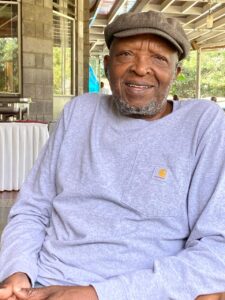
Who is Mzee Njuguna Mwangi
Research. Memory. Decolonizing the African Mind
Njuguna Mwangi is a Kenyan economist, international development specialist, researcher, and author whose life's work explores the intersection of African history, culture, religion, economics, and the Abrahamic Religion Tree.
For more than five decades, he has pursued one enduring question: How did Africa lose ownership of its own story, and how can that story be recovered? This website is his contribution to that journey. Inspired by the late Ngũgĩ wa Thiong'o's call to decolonise the mind, Njuguna invites readers to go beyond slogans and examine the historical, cultural, and spiritual forces that shaped modern Africa. His work combines historical research, biblical study, oral tradition, economic analysis, and lived African experience—not to promote ideology, but to encourage thoughtful inquiry grounded in evidence.
A Lifetime of Research and Public
Njuguna's research career began in 1973 while serving in the Government of Kenya, where he worked on national development planning, Five-Year Development Plans, and public policy research. Rising through the ranks to become Chief Macroeconomist, he published economic research with regional and international institutions, including the African Economic Research Consortium (AERC), CIDA, and other development organizations. After leaving government in 1994, he became an international consultant, working with organizations such as the World Bank, IMF, UNDP, UNEP, UNESCO, UNU-WIDER, UNFPA, ODA/DFID, the Ford Foundation, and COMESA. His work took him across Sub-Saharan Africa, with one of his most memorable assignments being the Reconstruction and Development Commission in the Office of President Nelson Mandela in South Africa (1995).
His research was later recognised through contributions to the 1996 and 1998 Human Development Reports, and in 1999 he led the team that produced Liberia's first Post-War Human Development Report (2000). He concluded his international career as United Nations Chief Technical Adviser on Economic Management in Liberia and The Gambia before retiring. Click to see Retirement did not end his work—it gave him the freedom to write the books he had been carrying in his mind for decades.
Why Does This Website Exist?
Ngũgĩ wa Thiong'o argued that colonialism occupied more than African land—it also occupied African minds. Njuguna believes those words deserve careful study, because many people repeat them without fully understanding their meaning. This website is therefore a public research library. It brings together books, articles, essays, and historical reflections that encourage readers to ask difficult questions and examine the evidence for themselves.
Among those questions are:·
The invitation is simple: read widely, compare sources, and think for yourself. That is the beginning of decolonising the mind. Culture, Religion, and the Abrahamic Religion TreeOne of Njuguna's major areas of research is the relationship between African culture and the Abrahamic religions. He argues that many misunderstandings surrounding Christianity in Africa arose not from the Bible itself, but from the way Christianity was introduced during colonial rule. A central focus of his work is the Council of Jerusalem in Acts 15, which he describes as a defining moment in the emergence of Christianity as a universal faith (the original meaning of the Greek word Catholic). The council concluded that Gentile believers (all humanity not brought up in the Jewish culture that is first Covenant of Jews observing 613 Gods Commandments/Mosaic Laws/ Mitzvah/Mitzvoth) were not required to adopt the full body of Jewish ceremonial law in order to become Christians.
His writings invite readers to study Scripture alongside church history and ask an important question: Was the universal message of Acts 15:20 fully applied within Africa's colonial experience? Rather than accepting inherited interpretations unquestioningly, he encourages readers to examine the biblical text, historical evidence, and missionary history together. Another important area of study is African names and identity. Drawing on passages such as Jeremiah 1:5, (Before I formed you in the womb, I knew you) Njuguna explores whether the replacement of indigenous names during baptism became part of a broader colonial process that associated European identity with spiritual superiority. His books investigate these questions through theology, history, and African cultural memory.
Historiography: Who Tells Africa's Story?
Historiography is the study of how history is written. Njuguna believes that recovering Africa's past requires bringing together colonial archives, missionary records, academic scholarship, oral testimony, and community memory.
No single source is complete. Throughout his work, he carefully distinguishes documented evidence from oral tradition while showing how both contribute to a fuller understanding of African history. This approach is especially evident in his research on the Mau Mau struggle, Kikuyu civilisation, genealogy, marriage, and indigenous systems of governance.
From Economics to Cultural Restoration
Although many readers first encountered Njuguna through his work in economics and international development, his later writings increasingly focus on Kikuyu genealogy, marriage, language, and cultural philosophy. Growing up in the presence of a respected Mũndũ Mũgo—a custodian of community knowledge—he witnessed traditions that were rarely documented and were often misunderstood during the colonial period. Those experiences became the foundation of his cultural research.
Why Were There Sixteen Sittings in Kikuyu Marriage?
In his books on Ũthoni wa Ũgĩkũyũ, Njuguna demonstrates that traditional Kikuyu marriage was a carefully organised social institution consisting of sixteen sittings, each with a distinct purpose. These gatherings were not random ceremonies; they provided a structured process for family approval, clan verification, character assessment, and community accountability. He traces the origins of familiar expressions such as Njohi ya Njurio, Mwati na Harika, and Njohi ya Mathĩgĩ, showing how many commonly repeated sayings have survived while their original meaning has gradually been forgotten. His books do not romanticise the past. Instead, they seek to distinguish authentic African institutions from the colonial cultural baggage that was often presented in the name of Christianity. The goal is restoration through understanding—not nostalgia.