

Why the Battle for Africa Is Far from Over
“The whole import-export relationship between Africa and its trading partners is one of unequal exchange and of exploitation.”
Walter Rodney, How Europe Underdeveloped Africa
Why should every young African understand the Four Ages of extraction?
What if every generation of your family witnessed a different way in which Africa lost its wealth? Your great-grandparents watched Africa’s natural wealth leave through ancient trade routes. Your grandparents witnessed Africans being carried away in chains. Your parents celebrated political independence with hope and optimism. Today, your generation is watching debt rise, profits flow abroad, and much of Africa’s economic value leave through channels far less visible than the ships and armies of the past. The ships have changed. The contracts have changed. Even the language has changed. Yet one question continues to echo across the continent: Who benefits most from Africa’s wealth?
Many young Africans were taught that colonialism ended when our countries gained independence. We proudly celebrate our flags, national anthems, and the right to choose our leaders. These achievements deserve celebration. Political independence was one of the greatest milestones in African history. Yet political freedom does not automatically guarantee economic freedom.

That reality raises difficult but necessary questions. If Africa is richly endowed with gold, diamonds, oil, fertile land, forests, cobalt, lithium, rare earth minerals, and one of the world’s youngest populations, why do so many African countries continue to struggle with unemployment, debt, poverty, and dependence on external financing?
Why do nations blessed with extraordinary natural wealth often find themselves borrowing to fund development? And why does so much of the value created from African resources continue to accumulate elsewhere?
These are not questions of blame. They are questions of understanding. A doctor cannot prescribe the right treatment without first understanding the illness. Likewise, Africa cannot chart a confident economic future without honestly examining the historical forces that shaped its present.
Decades ago, the Guyanese historian Walter Rodney challenged the world to rethink Africa’s economic history. In How Europe Underdeveloped Africa, he argued that Africa’s underdevelopment did not occur by accident. Over many centuries, wealth, labour, knowledge, and economic value were transferred from the continent through changing historical systems. Although each period looked different, they often shared one common feature: Africa supplied much of the wealth while others captured much of the lasting value.
Rodney’s work does not explain every challenge confronting Africa today. Poor governance, corruption, conflict, weak institutions, and policy failures have also played significant roles. Nevertheless, his central insight remains highly relevant. To understand where Africa stands today, we must first understand the broad historical patterns that shaped its economic journey.
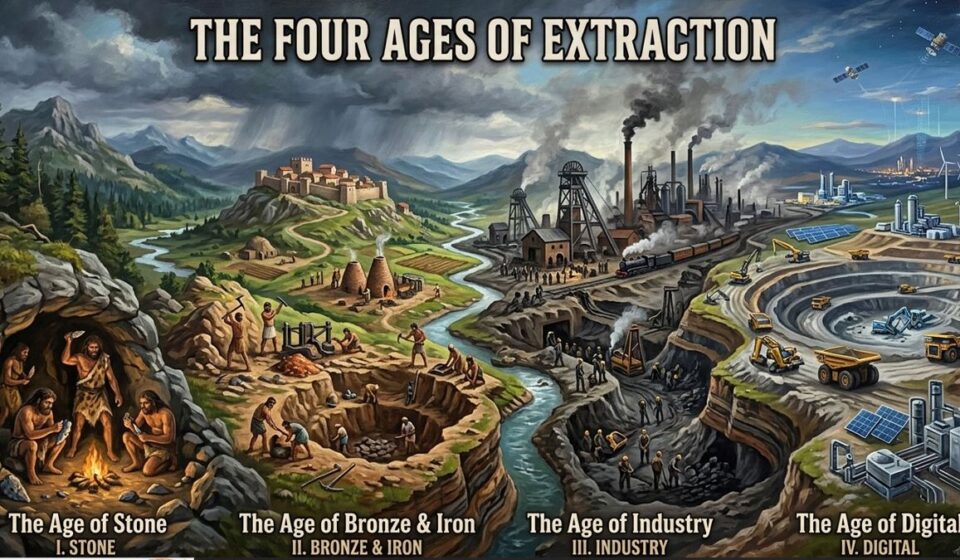
Viewed through this lens, Africa’s relationship with the global economy can be understood through four broad ages of extraction. Each age used different methods, each belonged to a different historical period, yet each raises the same enduring question: Who controls the value created from Africa’s resources, labour, and human potential?
Age | Approx. Period | Primary form of extraction | Central question |
Age one | c. AD 800–1500 | Natural wealth | Why did Africa export raw wealth before developing industries around it? |
Age two | c. AD 1500–1800s | Human beings | What happens when a continent loses millions of its most productive people? |
Age three | c. 1884–1960s | Resources, land, labour & economic surplus | How did colonial rule institutionalize extraction? |
Age four | 1960s–Present | Economic value, finance & global value chains | Has extraction changed its form rather than disappeared? |
The fifth age? | The Future | African value creation | How can Africa create, retain, and multiply more of its own value? |
Age one (c. AD 800–1500): Why did Africa’s natural wealth leave before its industries grew?
Long before European colonial rule, Africa was home to flourishing kingdoms, sophisticated trading networks, and prosperous commercial centres. Far from being isolated, the continent was deeply connected to the wider world. Across West Africa, the great empires of Ghana, Mali, and Songhai controlled lucrative trans-Saharan trade routes. Cities such as Timbuktu and Gao became renowned not only as commercial hubs but also as centres of scholarship, attracting merchants, scholars, and travellers from North Africa and beyond.
On the eastern coast, prosperous Swahili city-states including Kilwa Kisiwani, Mombasa, Malindi, and Pate linked Africa to Arabia, Persia, India, and China through the seasonal monsoon winds of the Indian Ocean. Further south, the Kingdom of Great Zimbabwe accumulated considerable wealth through the trade of gold and ivory exported via the port of Sofala in present-day Mozambique. These examples remind us that Africa was not waiting to be discovered. It was already participating in regional and international commerce centuries before colonialism.
Gold from West Africa, ivory from East Africa, copper from Central Africa, salt from the Sahara, and many other commodities travelled along well-established trade routes. Trade itself was never the problem. Throughout history, commerce has been one of humanity’s greatest engines of prosperity, innovation, and cultural exchange.
The challenge emerged gradually as external demand for Africa’s raw materials grew faster than Africa’s capacity to process them. Increasingly, valuable resources left the continent in their natural state, while industries capable of refining, manufacturing, branding, and adding value developed elsewhere. Over time, this created an imbalance whose effects can still be seen today.
Imagine two neighbouring coffee farmers. Both harvest excellent coffee cherries. One sells the cherries immediately after harvest and receives payment only for the raw crop. The other roasts the beans, packages them attractively, builds a respected brand, opens cafés, and exports premium coffee around the world. Although both began with the same harvest, their earnings are vastly different because one sells a raw product while the other sells value.
This illustration is particularly familiar to Kenyans. Kenya produces some of the world’s finest Arabica coffee, yet for many years much of it has been exported in green bean form before roasting, packaging, branding, and retailing take place elsewhere. The greatest profits are often earned further along the value chain than at the farm gate.
The same pattern can be seen elsewhere across Africa. Ghana and Côte d’Ivoire produce most of the world’s cocoa beans, yet a large share of the global chocolate industry is located outside Africa. Minerals leave African soil to be refined abroad before returning as high-value manufactured products. The lesson is not that trade is harmful. Rather, it is that nations capture greater prosperity when they participate not only in production but also in processing, manufacturing, innovation, finance, and marketing. Perhaps this is the first great lesson in Africa’s economic story. Wealth is not determined only by what lies beneath the ground. It is determined by what a nation is able to do with what lies beneath the ground.
Age two (c. AD 1500–1800s): how did the extraction of people become Africa’s greatest loss?
If the First Age of Extraction centred on Africa’s natural wealth, the Second Age shifted attention to something even more valuable, its people. As European demand for labour expanded in the Americas and elsewhere, millions of Africans were forcibly removed from their homes through the Atlantic and Indian Ocean slave trades. Historians continue to debate the exact numbers, but there is no disagreement about the scale of the tragedy. For more than three centuries, countless men, women, and children were torn from their families, marched to distant coastal settlements, and transported across oceans under unimaginable conditions.
The story of this period is still written into the landscape of Africa itself. Along the coast of present-day Ghana, the massive stone fortresses of Elmina Castle and Cape Coast Castle became major departure points for enslaved Africans destined for the Americas. Visitors who walk through the narrow corridors today eventually reach the haunting “Door of No Return,” the final exit through which countless captives passed before boarding slave ships.
On Africa’s eastern coast, Bagamoyo in present-day Tanzania and the island of Zanzibar became important centres of the Indian Ocean slave trade. Caravans travelled for weeks from the interior, bringing ivory and enslaved people to the coast before they were transported to the Middle East, Persia, India, and islands across the Indian Ocean. Today, these places remain powerful reminders of one of humanity’s darkest chapters. Yet the greatest loss cannot be measured only by the number of people who left Africa.
Africa did not simply lose millions of individuals. It lost farmers who would have cultivated the land, blacksmiths who would have forged tools, builders who would have constructed towns, traders who would have expanded commerce, mothers and fathers who would have raised future generations, and leaders whose wisdom might have strengthened their communities. Every ship that sailed away carried not only human beings but also skills, knowledge, creativity, and unrealised potential.
Imagine a village that loses most of its young adults. The fields remain untilled. Fewer children are born. Skills are no longer passed from one generation to the next. Markets become quieter, and communities struggle to defend themselves. Now imagine that happening repeatedly across hundreds of communities over many generations. The damage extends far beyond the lives immediately affected; it alters the future of an entire society.
This is why many historians describe the slave trade as a profound loss of human capital. Modern economists use that term to describe the education, skills, experience, health, and productive capacity of people. Long before the phrase existed, Africa had already suffered one of history’s greatest losses of human capital.
The consequences were not uniform across the continent. Some African societies were affected more severely than others, and the causes of the slave trades were complex, involving African rulers, merchants, Arab traders, and European commercial interests in different regions and at different times. A balanced understanding of history requires acknowledging that responsibility was shared in varying ways. Yet the overwhelming reality remains that the greatest beneficiaries of these systems were found outside Africa, while the continent bore the lasting demographic, economic, and social costs.
Even today, the effects can still be felt. Population growth in some regions was disrupted for generations. Communities were divided. Trust was eroded as fear and insecurity spread. Some societies redirected enormous energy towards survival instead of innovation, production, and long-term development. The cost was not merely counted in lives lost but in opportunities never realised.
Kenya also experienced this painful history, although in a different way from West Africa. The East African slave trade reached deep into the interior through caravan routes linking present-day Taita, Ukambani, Taveta, and the Lake Victoria region to the coastal markets of Mombasa, Bagamoyo, and Zanzibar. While the numbers were smaller than those of the Atlantic trade, families were still separated, communities disrupted, and local economies weakened. The scars of that history remain part of East Africa’s collective memory.
Perhaps the greatest tragedy is this: Africa was not only exporting people; it was exporting the very generation that would have built its future. This is why the Second Age of Extraction represented more than a humanitarian catastrophe. It fundamentally interrupted Africa’s capacity to accumulate knowledge, strengthen institutions, and expand its productive economy. A continent that had already been losing increasing amounts of its natural wealth was now losing its greatest resource, its people.
As the abolition of the slave trade gathered momentum during the nineteenth century, the struggle for Africa entered a new phase. European powers no longer sought merely to trade with Africa or remove its people. Increasingly, they sought to control African territory itself, reorganising entire economies to serve imperial interests. The extraction of resources would continue, but now under direct political authority.
Age Three (c. 1884–1960s): How did colonial rule turn extraction into an economic system?
The abolition of the transatlantic slave trade did not end the world’s economic interest in Africa. Instead, it marked the beginning of a new phase. If the Second Age extracted Africa’s people, the Third Age sought something even more ambitious—the direct control of African land, resources, labour, and production.
The turning point came during the Berlin Conference of 1884–1885, when European powers met to establish rules for claiming African territory. Remarkably, no African ruler was invited to participate in decisions that would reshape the political map of an entire continent. Within a few decades, almost all of Africa had been partitioned among European colonial powers, each administering its territories according to its own political and economic priorities.
Colonial governments introduced new administrative systems, taxation, legal codes, and infrastructure. Some of these institutions later became important foundations for modern African states. Yet their original purpose was largely economic: to organise production, secure labour, maintain order, and facilitate the movement of export commodities from the interior to overseas markets.
In many colonies, agriculture was reorganised around cash crops rather than food production. Coffee, tea, cotton, cocoa, sisal, rubber, tobacco, and groundnuts became central to colonial economies because they generated income through international trade. Africa increasingly supplied raw materials to industries located elsewhere, while manufactured goods flowed back into African markets.
Kenya illustrates this transformation clearly. Following the establishment of the British East Africa Protectorate, large areas of fertile land in the central highlands—including parts of present-day Kiambu, Nyeri, Nakuru, Uasin Gishu, and Laikipia—were gradually alienated for European settlement. These areas later became known as the White Highlands. Many African communities were displaced, confined to reserves, or required to provide labour for settler farms and colonial projects. The resulting changes altered patterns of land ownership, agricultural production, and rural livelihoods for generations.
To encourage participation in the colonial economy, taxes such as the hut tax and poll tax were introduced. Because these taxes generally had to be paid in money rather than produce, many Africans entered wage employment on settler farms, public works, or in colonial administration. Labour, once organised primarily around family and community needs, increasingly became integrated into a cash economy. Infrastructure expanded during this period, but it served specific economic priorities.
The Uganda Railway, constructed between 1896 and 1901, connected the port of Mombasa to Lake Victoria, opening the interior to increased commercial activity. The railway later became one of Kenya’s most important national assets, facilitating trade, travel, and economic integration after independence. However, its original design reflected colonial priorities: it enabled the efficient movement of export crops, administrative personnel, and military resources between the interior and the coast.
Similar patterns appeared across the continent. Railways linked the Copperbelt of present-day Zambia and the Democratic Republic of Congo to ports in southern Africa, allowing copper to reach international markets. In South Africa, railway networks expanded to serve the goldfields of the Witwatersrand and the diamond mines of Kimberley. Across the continent, infrastructure often connected mines and plantations to ports more efficiently than it connected neighbouring African communities to one another.
This does not mean that every railway, road, or administrative institution lacked long-term value. Independent African governments inherited and expanded many of these systems, and they continue to play an important role in national development today. The historical point is more specific: the original economic design of many colonial institutions was closely linked to extraction and export.
The same pattern appeared in manufacturing. Raw materials commonly left Africa with limited processing taking place locally. Cotton grown in Uganda was exported before being transformed into textiles abroad. Cocoa harvested in the Gold Coast—today’s Ghana—was processed into chocolate elsewhere. Copper mined in Northern Rhodesia, now Zambia, generated far greater value after refining and manufacturing outside Africa. Kenya’s coffee and tea became internationally recognised products, yet much of the roasting, blending, packaging, and branding occurred overseas, where larger shares of the final profits were captured.
Imagine a carpenter who carefully cuts down a magnificent tree but sells only rough logs. Another craftsman purchases the timber, transforms it into elegant furniture, and earns many times more than the original seller. The greatest wealth often lies not in possessing the raw material but in adding value to it.
This principle remains one of the most important lessons in economics. Nations rarely become prosperous by exporting raw materials alone. Sustainable prosperity usually grows where countries develop industries capable of processing, manufacturing, innovating, branding, financing, and marketing their own products.
By the time political independence began sweeping across Africa during the late 1950s and 1960s, many newly independent governments inherited economies designed primarily to export commodities and import manufactured goods. Building diversified industries, strengthening local manufacturing, and reducing dependence on raw commodity exports became some of the defining economic challenges of the post-independence era.
Political freedom had been achieved, but economic transformation would prove to be a far longer journey. This is why the Third Age of Extraction did not end neatly with the lowering of colonial flags. While colonial rule formally came to an end, many of the economic structures established during that period continued to influence trade, investment, and patterns of development long after independence.
The question confronting newly independent African nations was therefore no longer simply who governs? It became an equally important question: Who controls the production of wealth, the creation of value, and the direction of economic development? Those questions would define the Fourth Age of Extraction, where political sovereignty existed alongside new forms of economic dependence, global finance, and increasingly complex value chains.
Age Four (1960s–Present): Has extraction changed its form rather than disappeared?
When African countries began gaining independence during the late 1950s and 1960s, millions celebrated with genuine hope. Across the continent, new flags were raised, national anthems composed, and African leaders assumed responsibility for governing their own countries. For the first time in generations, political authority rested largely in African hands.
Independence was a remarkable achievement. It restored dignity, self-determination, and the right of African peoples to shape their own future. Yet political independence did not automatically transform economic structures that had developed over many decades.
The export of raw materials continued. Manufactured goods continued to be imported. Foreign investment remained important. International trade expanded rapidly. Global financial institutions grew in influence. In many respects, the world entered a new economic era—one characterised less by territorial conquest and more by markets, finance, technology, investment, and global supply chains.This is what makes the Fourth Age of Extraction more difficult to recognise.
Unlike earlier periods, there are no colonial governors, no partition conferences, and no foreign flags flying over African capitals. Instead, today’s global economy is shaped by trade agreements, multinational corporations, financial markets, international lending, and increasingly sophisticated value chains. These systems have helped create opportunities for investment and economic growth, but they have also raised important questions about who captures the greatest share of the value created from Africa’s resources.
The issue is no longer simply who owns the mine, the farm, or the oil field. Increasingly, the question is: Who controls the processing, technology, branding, financing, distribution, and intellectual property that create most of the value? That question lies at the heart of the Fourth Age.
Why does value addition matter more than ever?
Consider a simple cup of coffee. A farmer in Nyeri, Kirinyaga, or Murang’a carefully tends coffee trees for years before harvesting ripe cherries. After processing, much of the coffee may be exported as green beans. Thousands of kilometres away, companies roast the beans, create premium blends, package them attractively, market them globally, and sell each cup at many times the value of the original crop. The farmer produced an exceptional agricultural product, yet the largest profits are often generated after the coffee has left Kenya.
The same pattern appears elsewhere across Africa. Ghana and Côte d’Ivoire produce nearly sixty percent of the world’s cocoa beans, yet much of the global chocolate industry remains concentrated in Europe and North America. The Democratic Republic of Congo supplies much of the world’s cobalt, a mineral essential for rechargeable batteries used in electric vehicles, laptops, and smartphones. Zimbabwe possesses significant lithium reserves that are becoming increasingly important in the global transition to renewable energy.
These examples do not suggest that international trade is unfair by definition. Rather, they illustrate an important economic principle: The greatest wealth is often created not by extracting raw materials, but by transforming them into higher-value products and services.
What Does Debt Have to Do with the Fourth Age?
Another defining feature of this age is the growing role of public finance and international borrowing. Almost every country in the world borrows money. Governments borrow to build roads, railways, ports, hospitals, power stations, schools, and digital infrastructure. When managed responsibly, borrowing can accelerate development by financing investments that generate future economic growth. Debt, therefore, is not the problem.
The more important question is whether borrowed resources create productive capacity capable of repaying the loans. Do they strengthen manufacturing? Do they improve agricultural productivity? Do they support innovation? Do they expand exports? Do they create sustainable employment? Or do they leave future generations carrying obligations without equivalent economic returns? These are not easy questions, but they are necessary ones. For many young Kenyans, they are also deeply personal.
Conversations about public debt, taxation, unemployment, and the rising cost of living have become part of everyday life. Many citizens understandably ask whether borrowing is translating into sufficient opportunities for businesses, farmers, entrepreneurs, and young graduates.
These questions deserve careful discussion rather than simple slogans. Responsible borrowing can support national development. Equally, borrowing that is not matched by productive investment can place increasing pressure on future generations. The challenge is therefore not merely how much a country borrows, but how effectively those resources are invested.
Could the smartphone in your pocket tell Africa’s story?
Pick up your smartphone for a moment, its battery may contain cobalt mined in the Democratic Republic of Congo. Tiny amounts of gold may have originated in Ghana or South Africa. Copper may have come from Zambia. Rare minerals may have been extracted from Zimbabwe or Mozambique. Yet the phone itself was likely designed in one country, manufactured in another, assembled in yet another, branded elsewhere, and sold globally through companies whose greatest assets are technology, research, design, and intellectual property. Africa supplied many of the ingredients. Others often captured much of the final value.
That observation is not an argument against global trade. Rather, it illustrates why economists increasingly emphasise value chains rather than simply natural resources. The future belongs not only to those who possess raw materials but also to those who develop knowledge, technology, innovation, manufacturing, branding, logistics, and finance.
Does the Fourth Age explain all of Africa’s challenges?
Certainly not. It would be both inaccurate and unfair to attribute every contemporary challenge to historical extraction or external economic relationships. Africa’s own choices matter enormously. Corruption, poor governance, political instability, weak institutions, ethnic conflict, policy inconsistency, and inadequate investment in education, research, and industrialisation have all limited economic progress in different countries. History helps explain the starting point, leadership influences the destination.
Recognising external historical influences should never become an excuse for avoiding internal responsibility. Likewise, acknowledging internal failures should never prevent an honest examination of the international economic structures within which African countries continue to operate. Both realities can be true at the same time.
Could the Fifth Age become the age of African value creation?
Every age of extraction took something different. The First Age drew increasing amounts of Africa’s natural wealth into expanding global trade. The Second Age carried away millions of Africa’s people. The Third Age organised extraction through colonial administration and export-oriented economies. The Fourth Age reminds us that, in a globalised world, value often moves through finance, technology, intellectual property, manufacturing, and international supply chains.
Yet history is not destiny. Every generation has the opportunity to write a different chapter. Perhaps the Fifth Age should not be remembered as another period of extraction. Perhaps it should become the Age of African Value Creation. An Africa that processes more of its own minerals before export. An Africa that roasts more of its own coffee and manufactures more of its own chocolate. An Africa that transforms lithium into batteries rather than exporting raw ore alone. An Africa that strengthens universities, supports scientific research, encourages innovation, expands manufacturing, and builds globally competitive industries. An Africa that trades more with itself through the African Continental Free Trade Area (AfCFTA) while remaining an active participant in the global economy.
The battle for Africa has never been only about territory. It has always been about who creates value, who captures value, and who determines the continent’s economic future. That future will not be shaped by history alone. It will also be shaped by the decisions Africans make today.
The greatest inheritance we can leave the next generation is not merely ownership of Africa’s resources, but the knowledge, institutions, industries, and leadership needed to transform those resources into lasting prosperity.