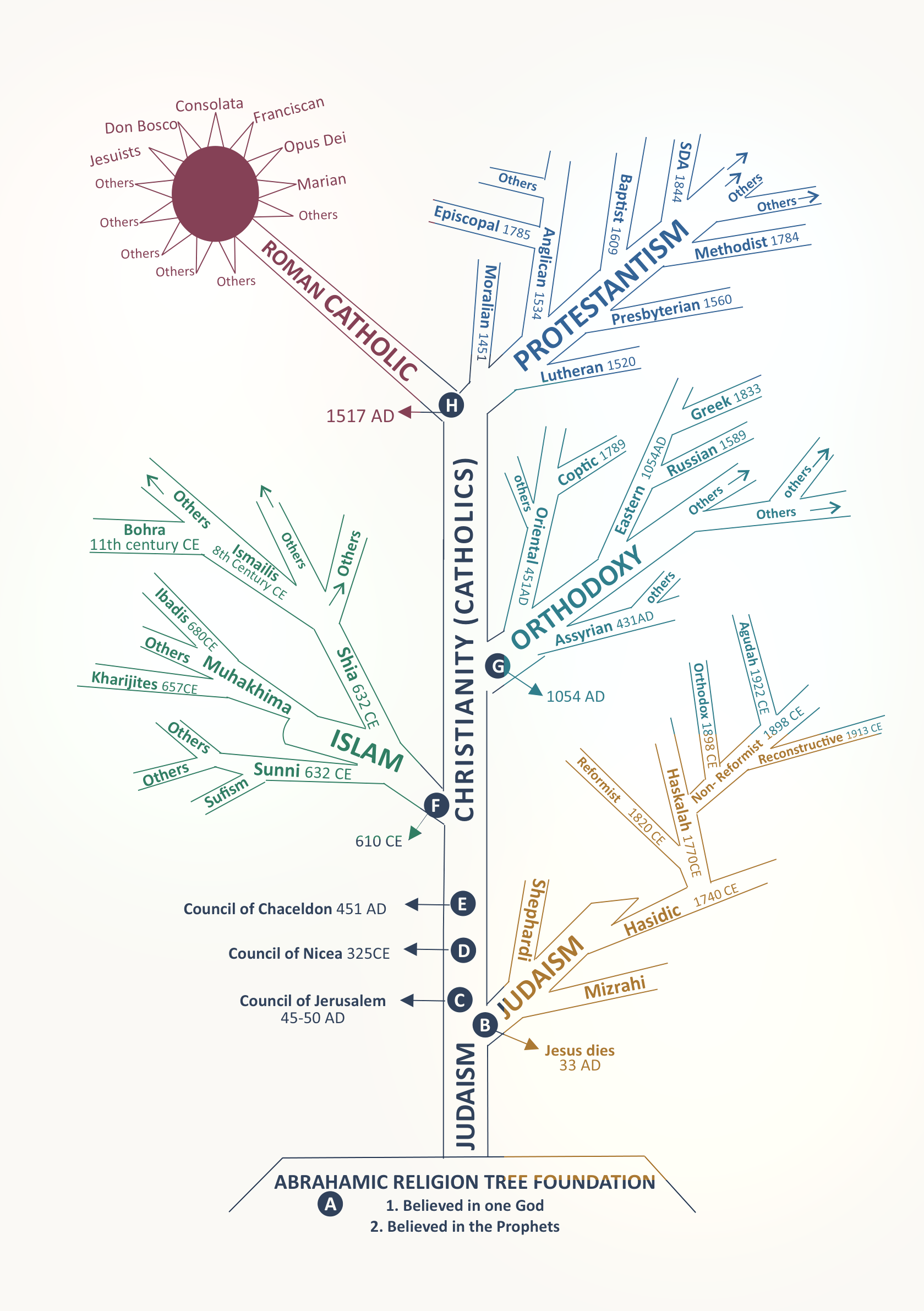
A) Abrahamic Religion foundation, believing in One God and the Prophets.
B) Jesus dies (33 CE). Judaism emerges as the first main branch of the tree, with subsequent sub-branches.
C) Council of Jerusalem (48-50 CE).
– Admitted all cultures of the world (Gentiles) to Christianity.
– Agreed God created all people in different cultures.
– Accepted that God had the power to create all of them as Jews but chose to create them differently with a purpose.
– Agreed that all people should follow the New Covenant of Jesus in their relationship with God, leaving behind only their old cultural practices in worship that were incompatible with the new Covenants. These were: Worship of and sacrifices to idols, eating meat from sacrifices to idols, male circumcision.
D) Council of Nicea (325 CE).
– Established the concept of the Trinity to address the debate about how there can be three Gods in an Abrahamic religion (Father, Son, and Holy Spirit).
– The Nicene Creed defined the Christian Godhead as an equilateral triangle.
E) Council of Chalcedon (451 CE)
– Reaffirmed the dual nature (Divine and Human) and wills of Jesus.
-This reaffirmation led some former Christians to convert to Islam and Orthodox Christians centuries later.
F) Islam: Emerged after the Hijrah on July 16, 622.
– Rejected the idea of Jesus as God, instead recognizing Him as Prophet Issa.
– This branch has sub-branches that developed over time.
G) Orthodoxy 1054 CE: Maintained the divine nature and will of
Christ contrary to the decree of the Council of Chalcedon.
H) The major split of the two branchesoccurred in 1517.
– The Roman Catholic Christian branch with various divisions.
– Protestant sub-branch includes Lutheran, Anglican, and many 0thers, with further subdivisions evolving as shown in the diagram. These sub-branches continue to develop to this day.