
He carried no gun, yet he saved lives: The story of Mzee Kibaba
Can a quiet man save lives without firing a shot?
When we remember the struggle for Kenya’s independence, our minds naturally go to the men and women who took up arms, went into the forests, endured detention, or openly confronted the colonial government. But history is not made only by those who carried guns. Sometimes, it is also shaped by people whose names never appeared in newspapers or history books, people who used their influence, courage and wisdom quietly, at a critical moment.
In my memories of the Mau Mau period, one such person stands out: Mzee Wainaina Kibaba, a respected mũndũ mũgo (a traditional healer and diviner). To me, he was an unsung hero and a protector of our community.
His story is remarkable because he was respected by people on both sides of the conflict. Loyalists came to him. Mau Mau supporters came to him. And at a time when suspicion could mean death, he appears to have moved between these worlds with remarkable influence. Most importantly, his intervention helped prevent what could have become a massacre at the Kiriku Protected Camp.
But how did a traditional healer come to occupy such an unusual position during the Emergency?
Why was Mzee Kibaba respected by both sides? Before the State of Emergency was declared in October 1952, Mzee Kibaba was already a highly respected member of the community. People came to his thingira seeking counselling, prayers and herbal medicines. As a young boy, I sometimes had the responsibility of collecting herbs for him.
His thingira was more than a dwelling. It was a place where people came to talk, seek advice and ask for help. Then the Emergency changed everything. The colonial government introduced increasingly severe controls. Communities were moved into protected villages. Homes were demolished and people were placed in rows of huts designed to make movement and surveillance easier.
Yet something unusual happened at Mzee Kibaba’s home. His thingira was not demolished. Instead, the new huts were built around it. I still remember its entrance. At first, it had a rĩgi (a traditional door made from narrow branches fastened together). Later, a wooden door was fitted. The door was never locked, but the entrance was low. Adults had to bend slightly to enter. As a six- or seven-year-old boy, I could walk in without difficulty. That small detail has stayed with me.
In the middle of a tightly controlled village, where ordinary people were being watched and restricted, Mzee Kibaba’s thingira remained standing. Why?
Why did even the home guards go to him?
The answer may lie partly in the respect he commanded. The colonial government’s local forces included African home guards, known locally as ngati. They were feared by villagers because of their role in enforcing colonial orders.
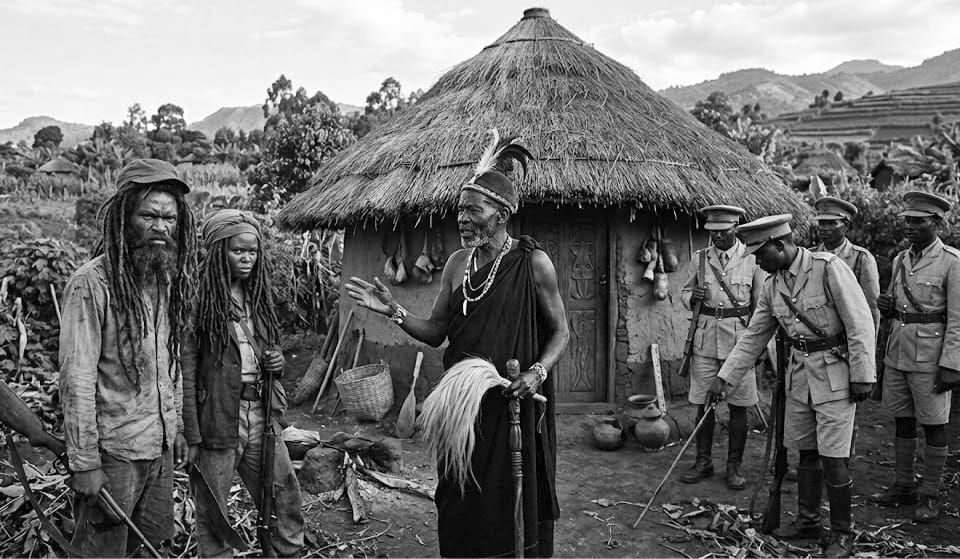
People were forced to undertake communal labour. Some were beaten or whipped. During security operations, people could be killed. Yet some of these same home guards came to Mzee Kibaba. There were whispers in the community that during the day he attended to the ngati, while at night he attended to freedom fighters.
As a child, I did not understand what this meant. I only knew that people came and went.
Much later, I learned that Mzee Kibaba provided a traditional protective medicine or charm known as Mũgitĩri to people on both sides. The irony was striking. Some of the home guards had Christian names and publicly presented themselves as supporters of the colonial order. Yet, according to what was later told within the community, some still sought the services of the mũndũ mũgo.
Perhaps they came for information. Perhaps they came because they were afraid. Perhaps they came for protection, or perhaps it was all three. Whatever the reason, one thing is clear from the memories passed down: Mzee Kibaba had influence that crossed the lines dividing the community. And that influence would become crucial.
What happened at the Kiriku Protected Camp?
To understand the significance of Mzee Kibaba’s intervention, we need to understand what was happening around Kiriku. The Kiriku Protected Camp was under colonial control. Civil servants working in the area slept there, including my father. The camp was also associated with colonial security personnel, including home guards.
By this stage of the Emergency, violence had produced deep anger and a desire for revenge. Prominent freedom fighters had been brutally killed, and the deaths had intensified the hostility between the two sides.
The local Mau Mau field commanders therefore considered attacking the Kiriku camp. Their plan, as I later learned, was to destroy the camp and kill those inside it. To them, this was retaliation, but retaliation can quickly become something much larger. If the attack succeeded, the consequences for the surrounding community could have been devastating, and that is where Mzee Kibaba entered the story.
Could revenge have turned into a massacre?
The memory of Lari was already present. The violence at Lari in Kiambu had demonstrated how quickly retaliation could engulf an entire community, Mzee Kibaba understood this danger. According to what I later learned from his sons, the late Peter Mwangi and his surviving brother Charles Kariuki, two representatives of the Mau Mau fighters came to Mzee Kibaba to obtain Mũgitĩri before the planned attack.
He gave them what they had come for, but he did something more important. He advised them not to attack the camp. His warning was practical, if they killed everyone at Kiriku, he told them, the consequences would not end there. The young men of Gathera sub-location could be blamed for knowing about the planned attack and failing to report it. They could all be treated as Mau Mau collaborators. In other words, an attack intended as revenge against the colonial authorities could result in innocent members of the community being killed. It was a warning about the consequences of violence, not only for those being targeted, but also for those living nearby. The Mau Mau representatives listened. That decision may have saved many lives.
How did Mzee Kibaba help them leave safely?
After persuading the men to abandon the planned attack, Mzee Kibaba accompanied them towards Kiringiti. According to the account later shared with me, he drew what was understood within the tradition as a protective line and recited prayers or words intended to prevent enemies from crossing from the Kigumo side, where the District Officer’s administrative centre was located.
He then accompanied them towards the Irati River. There, he again drew a protective line and prayed. Finally, near the Gathimba stream, close to the former Rurihe homestead, he repeated the ritual before returning to his village. For a modern reader, these actions may be difficult to understand. But it is important to remember the world in which Mzee Kibaba lived.
For many people in that community, the mũndũ mũgo was not simply someone who treated physical illness. He occupied a wider social and spiritual role. People sought his advice, medicines, prayers and protection.
Whether one accepts the spiritual meaning attached to these practices or views them as expressions of the beliefs of that time, their social significance is difficult to ignore. Mzee Kibaba’s authority mattered, and on this occasion, he used that authority to discourage an attack.
How many lives were saved that night?
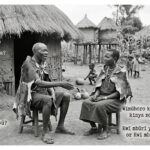
We may never know the exact number. There was no official report, no newspaper headline and, as far as I know, no public recognition, but the community remembered. Later, three old men and three old women came to Mzee Kibaba’s thingira carrying beer as a gesture of thanks for saving the lives of their loved ones.
That tells us something important, people may not have written his name into the official history of the Emergency, but they knew what he had done, and there is another reason why this story is deeply personal to me.
Did Mzee Kibaba save my father’s life?
Yes. My father was among the civil servants who slept at the Kiriku camp. Mzee Kibaba was also his half-brother. Had the planned attack gone ahead and everyone inside the camp been killed, my father could have been among the dead. So could Mzee Kibaba’s own sons, Peter Mwangi and Charles Kariuki.
When I reflect on this today, the story becomes much more than an episode from the Mau Mau period. It becomes part of my own family history. A man who lived quietly in our community may have prevented an event that could have changed the lives of several families, including mine.
Why have we forgotten people like Mzee Kibaba?
History often remembers the people who stood at the centre of dramatic events. It remembers commanders, politicians, chiefs, colonial officers and famous freedom fighters. But what about the people who prevented violence? What about those who carried messages? Those who hid people? Those who warned others? Those who persuaded angry men not to act? Those who quietly protected their neighbours? Their contributions can disappear because they do not fit neatly into the familiar story of war.
Mzee Kibaba did not become famous, he did not seek recognition, and he did not leave behind a public monument. Yet within our community, his actions were remembered. That is why I describe him as an unsung hero.
What can Mzee Kibaba’s story teach us about the struggle for independence?
The story reminds us that the struggle for independence was not simply a confrontation between two neatly defined groups. The reality on the ground was much more complicated. There were freedom fighters, there were loyalists, there were colonial officials, there were ordinary villagers caught between them, and there were people who, like Mzee Kibaba, had relationships across these dividing lines.
Fear existed on both sides, even those enforcing colonial authority could be frightened.
People who appeared powerful during the day could seek protection at night, and ordinary villagers often had to navigate a dangerous world where they could be suspected of supporting one side simply because they knew someone on the other. The Emergency was therefore not only a political struggle, it was also a deeply personal experience of fear, survival, loyalty, family and difficult choices.
What happened after the Emergency restrictions were relaxed?
The restrictions imposed on communities were gradually reduced from around 1958, although the timing varied from one area to another. Those living closer to the Aberdares and Mount Kenya were among the last to experience the relaxation of these controls.
For me, this change had a very practical consequence, I was finally able to attend school regularly. That may sound like a small detail, it was not. For a child growing up during the Emergency, simply being able to go to school regularly represented a return to something resembling normal life.
The political history of Kenya’s independence is often told through major events and famous names. But for children like me, history was also experienced through whether we could walk freely, whether our parents would return home, whether there would be another security operation, and whether we could go to school the next morning.
Why should we remember Mzee Kibaba today?
I remember Mzee Wainaina Kibaba not because he was a famous freedom fighter, but because he reminds us that courage can take many forms. Sometimes courage means taking up arms, sometimes it means refusing to cooperate with injustice, and sometimes it means standing before angry men and saying, “Do not do this. Think about what will happen to our people.” That kind of courage rarely makes headlines, but it can save lives.
Mzee Kibaba’s story also reminds us that our history is often preserved not only in government archives and official accounts, but in family memories, community stories and the recollections of those who lived through difficult times. I was a young boy during the Emergency. I could not understand the political forces shaping the world around me. But I remember the places, the people and some of the conversations.
Later in life, I learned more from those who had been there—including Mzee Kibaba’s sons, Peter Mwangi and Charles Kariuki. Those memories helped me understand the significance of what I had witnessed as a child.
Where can you read more about Mzee Kibaba and these memories?
This blog only gives a glimpse of the story, I have documented the story of Mzee Kibaba, the Kiriku incident, my childhood memories of the Emergency, and other experiences surrounding the Mau Mau period in greater detail in my memoir, Beyond Boundaries.
The memoir goes beyond the broad historical narrative to explore how the Emergency was experienced at the level of families, villages and ordinary people, the places where history is not simply recorded but lived. For readers interested in learning more about these memories and the people behind them, Beyond Boundaries provides a fuller account.
What if the quiet heroes were part of the story all along?
Perhaps that is the question with which I would leave the reader. When we look back at Kenya’s struggle for independence, do we remember only those who fought? Or do we also remember those who prevented unnecessary deaths? Do we remember the people who protected communities in ways that never appeared in official records?
Mzee Wainaina Kibaba deserves to be remembered as one of those people. He was a mũndũ mũgo, a traditional healer and diviner. He was respected by people on opposing sides of a brutal conflict. And, at a crucial moment, he used his influence to persuade Mau Mau fighters not to attack the Kiriku Protected Camp. In doing so, he may have saved many lives. He did not fire a shot. He did something else. He chose to protect life. That is why, in my memory of the Mau Mau years, Mzee Wainaina Kibaba will always remain an unsung hero and a protector of our community.

Other Articles