

How Agĩkũyũ Ngeithi Preserved Respect, Identity, and Community
Why Did a Greeting Matter So Much?
Have you ever greeted someone with “How are you?” without really expecting an answer? Today, greetings are often hurried formalities, exchanged before the conversation quickly moves on. Among the Agĩkũyũ of old, however, greetings were neither rushed nor superficial. They were the foundation of relationships. A greeting was more than an exchange of words. It affirmed that the other person mattered and recognized that they carried a family, a history, responsibilities, joys, and burdens. The first question was therefore not, “Why have you come?” but, “How are you?” Relationships came before business.
Before discussing marriage, settling disputes, conducting business, or sharing a meal, people first paused to acknowledge one another’s well-being. A meeting could not properly begin until everyone had greeted each other. Skipping the greeting could suggest impatience, disrespect, or even suspicion. This reflected a broader Agĩkũyũ understanding of well-being. A person whose heart was troubled might not think clearly or contribute wisely to community discussions. Wellness therefore extended beyond physical health to include peace of mind, family harmony, healthy livestock, productive farms, and God’s blessings upon the household.
Perhaps this is why traditional Agĩkũyũ greetings remain relevant today. In a world increasingly affected by loneliness, anxiety, and isolation, they remind us that genuine concern for another person’s well-being is never outdated.
What exactly was Ngeithi?
Ngeithi refers to the traditional Agĩkũyũ greetings exchanged whenever people met, whether privately or at gatherings such as weddings, initiation ceremonies, clan meetings, dispute resolutions, and harvest celebrations. No important proceedings began before everyone had been properly acknowledged. Greetings and introductions created the trust and respect needed before any serious discussion.
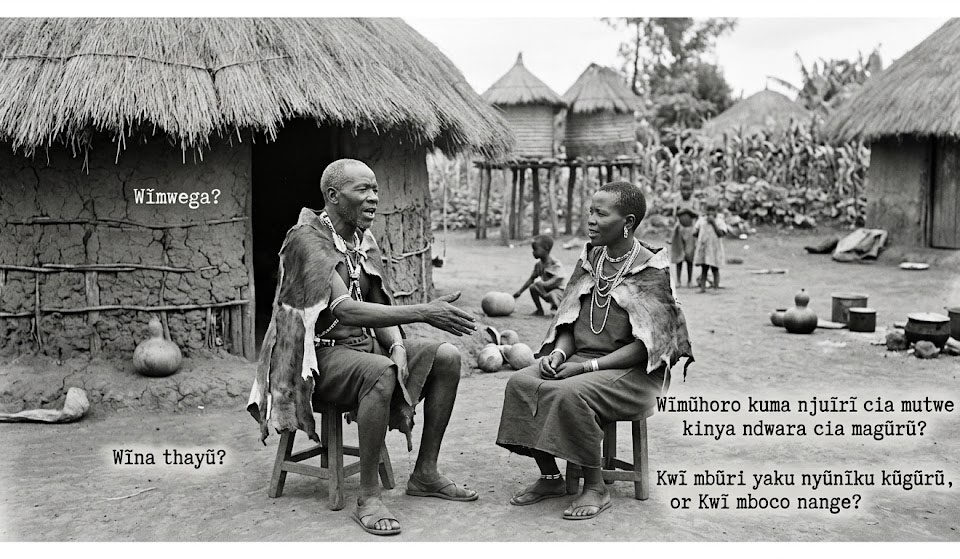
Unlike many modern greetings, ngeithi followed a cultural structure. Questions such as “Wĩmwega?” “Wĩna thayũ?” and “Wĩmũhoro… kuma njuĩrĩ cia mutwe kinya ndwara cia magũrũ?” expressed concern for a person’s complete well-being. Greetings also changed according to age, gender, relationship, and social status, with language carefully reflecting respect for elders and others of different standing. After asking about personal well-being, greetings often extended to family, farms, and livestock. A farmer might ask, “Kwĩ mboco nange?”—“Have any beans been trampled?”—or “Kwĩ mbũri yaku nyũnĩku kũgũrũ?”—“Has one of your goats broken a leg?” These were not casual questions. In an agricultural society, crops and livestock meant food, wealth, and security. Asking about them showed genuine concern for a neighbour’s welfare.
Ngeithi therefore reflected a deeply interconnected society. Unlike modern life, which can emphasize individual independence, traditional Agĩkũyũ society recognized that one person’s difficulties could eventually become everyone’s concern. A Ngeithi greeting did more than say hello; it said, “I see you, I care about you, and your well-being matters.”
How did greetings reveal respect and identity?
Traditional Agĩkũyũ greetings did more than exchange pleasantries; they revealed age, family relationships, respect, and social identity while guiding how a conversation should proceed. Although greetings varied slightly across regions, the underlying principles remained similar. In Gaki, present-day Nyeri County, elders were addressed with expressions such as maitũ, awa, or mũnyori, depending on the relationship and context. In Metumi and Kabete, greetings could be less formal but still respectful. Young people might address elders as Wĩmwega ithe wa… or Wĩmwega nyina wa…, acknowledging the honour attached to parenthood.
Greetings also reflected one’s upbringing. An elder could often tell from a young person’s words whether they had been properly taught at home. Courtesy was therefore not seen merely as an individual’s quality; it reflected the values of parents and grandparents. Someone who consistently spoke disrespectfully could raise questions about their character. The same principle still exists today. Whether in a job interview or when meeting a prospective son- or daughter-in-law’s family, first impressions often begin with how we greet others.
Were greetings merely polite words, or something deeper?
Traditional Agĩkũyũ greetings were more than polite exchanges. Asking about a person’s health, livestock, crops, family, and home reflected a holistic understanding of well-being in which physical, emotional, spiritual, and social life were inseparable.
To ask “Wĩmwega?” was not simply to ask whether someone was free from illness. It could mean asking whether there was peace at home, whether the children were well, whether the harvest was promising, and whether God was blessing the family’s work. This deeper meaning is captured in “Wĩna thayũ?”—“Do you have peace?”—and the response, “Ĩĩ ndĩna thayũ kuma njũĩrĩ kinya ndwara cia magũrũ,” meaning, “Yes, I have peace from the hair on my head to the toes of my feet.” It expressed complete well-being rather than health in isolation. Unlike today’s hurried “I’m fine,” often spoken when someone is struggling, ngeithi created space for genuine concern and listening. A culture that asks about your peace understand
Why did greetings change from one region to another?
Although Agĩkũyũ communities shared the same underlying values, greetings developed regional variations as language naturally evolved across different landscapes. In Metumi, Kabete, Gaki, and elsewhere, wording differed, but respect remained constant. Some communities preferred “Wĩmwega?”, while others used “Geithĩka?” or “Nĩ ndakũgeithia.” Some expressions emphasized affection or courtesy, while others reflected concern for someone returning after an absence.
These differences were not contradictions but regional expressions of the same culture—much like dialects within a language. The variations show that Agĩkũyũ culture was not rigid or frozen; it adapted to local circumstances while preserving enduring values of courtesy, empathy, and mutual recognition.The regional expressions that follow therefore capture not one fixed form of ngeithi, but the richness and diversity of Agĩkũyũ heritage.
Picture an elderly grandmother sitting outside her hut on a cool morning as young people greet her respectfully before continuing to the fields. Imagine neighbours meeting along narrow footpaths, each taking time to inquire about the other’s family before discussing the day’s work. Such scenes were repeated thousands of times across Kikuyu land, quietly strengthening relationships that held communities together. The exact words may have differed from one ridge to another, but the language of respect was understood everywhere.
How did greetings become a measure of character?
In traditional Agĩkũyũ society, greetings were judged not only by the words used but by how they were delivered. Humility, attentiveness, patience, tone, posture, and respect for elders all revealed one’s upbringing. Greetings were therefore part of moral education, learned from childhood by observing parents and elders rather than through formal lessons. Improper greetings could, in certain formal gatherings, attract thĩnjo, or traditional fines. These were not simply punishments but a way of protecting the dignity and harmony of weddings, reconciliation meetings, and clan gatherings.
The same principle survives today. In a job interview, people notice how we greet the receptionist, security guard, or employer before qualifications are discussed. Technology has changed, but human nature has not. Before people trust our words, they first observe our manners.
What can modern society learn from traditional greetings?
Modern technology allows us to communicate across continents instantly, yet many people feel increasingly disconnected. We ask, “How are you?” while looking at our phones and often answer, “Fine,” without expecting further conversation.
Traditional ngeithi offers a different vision: genuine communication requires presence, listening, and concern. Imagine communities where neighbours notice when a family is struggling or when someone suddenly disappears from public life. Asking about another person’s well-being would become more than etiquette—it would become an expression of care.
The old greetings were not merely preserving tradition; they were preserving people. Their wisdom remains relevant in a world rediscovering community, empathy, emotional intelligence, and meaningful conversation. The wisdom has never disappeared; it has simply been waiting to be remembered.
How did fear during the emergency period change the way people spoke?
Language changes with history. During Kenya’s State of Emergency declared in 1952, fear transformed ordinary conversations into cautious exchanges. Words carried weight because information could determine whether someone reached home safely or was arrested.
Imagine leaving home before sunrise in 1954, walking through the misty valleys of Gathera with a hoe over your shoulder. A barking dog, footsteps behind a hedge, or smoke from a homestead could suddenly signal danger. Meeting another villager, you would first exchange the customary greetings before asking the question that mattered most: “Ũhoro wa kũu umĩte?”—“What news do you bring from where you have come?”
This was no longer casual conversation. The answer might reveal a roadblock, arrests, a nearby military operation, or that the road ahead was safe. Information had become a form of protection. A simple greeting followed by a question about one’s journey had become an informal early-warning system through which villagers quietly looked after one another.
Why did ordinary conversation become mistaken for greetings?
Many younger Agĩkũyũ speakers today assume that expressions such as Ũhoro waku? Waigua atĩa? Kwerwo atĩa? and Nĩkwega? were traditional greetings. They were not. Traditional ngeithi focused on a person’s well-being—peace, health, and harmony—while these expressions were ndereti, conversational questions asked after greetings.
The distinction became blurred during the State of Emergency, when uncertainty made information about events beyond one’s village increasingly important. After exchanging the proper greetings, people might ask, “Waigua atĩa?”—“What have you heard?”, “Kwerwo atĩa?”—“What has been said?”, or “Nĩkwega?”—“Is everything all right where you have come from?” These were questions seeking information rather than expressions of courtesy. The historical context and meaning of these Emergency period expressions are explored in greater detail in my book, ũthoni wa Mũgĩkũyũ.
As such conversations became common, later generations inherited the expressions but gradually forgot the circumstances that gave them meaning. Sometimes a people remember the words while forgetting the history that created them.
What happened in the villages of Mount Kenya?
For many readers today, especially younger generations, the Emergency period exists only as a chapter in history books. Yet for those who lived through it, it was not history. It was daily life. Entire communities throughout the Mount Kenya region experienced fear, uncertainty, forced relocations, detention, executions, and constant surveillance. Families never knew whether loved ones would return after leaving home in the morning.
My own home area of Gathera bears painful memories of those years. Within the neighbouring villages of Kiiriangoro, Nyagachugu, and Itaaga, approximately twelve people were executed within a remarkably short period between late November 1953 and the early months of 1954. These were not distant stories reported in newspapers. They were neighbours, friends, fathers and sons. Men whose families expected them home but instead received devastating news.
Similar tragedies unfolded across much of the Mount Kenya region. The atmosphere became one of guoya na wĩhũgo (fear mixed with deep anxiety and uncertainty). People became cautious about where they travelled, whom they trusted, and even what they said in public. Nobody knew who might secretly be collaborating with the colonial administration or who might report an innocent conversation to the authorities. Under such conditions, language inevitably changed. Greetings became shorter, conversations became guarded, and questions became strategic. Every meeting carried an invisible calculation: Can I trust this person? Is it safe to continue?
Readers interested in a fuller account of these experiences will find many of these events described in greater detail in my memoir, Beyond Boundaries, where I recount how the Emergency transformed everyday life in our community. History is often written through battles and political declarations. Yet its deepest scars are frequently found in the ordinary conversations of ordinary people.
What does this teach us about language and memory?
One of the greatest tragedies of cultural erosion is that people sometimes inherit traditions without understanding their origins. A young speaker today may confidently use Ũhoro waku? as a greeting, unaware that their grandparents used those same words while trying to avoid deadly military operations. The words themselves are not wrong. What has disappeared is the memory attached to them.
Each generation enjoys its shade, but unless someone remembers who planted it, the tree eventually becomes just another object in the landscape. This is precisely why documenting Kikuyu customs matters. When history is forgotten, language becomes shallow. When language becomes shallow, culture slowly loses its depth. Recovering these meanings is therefore not an exercise in nostalgia. It is an act of cultural preservation. It allows younger generations to appreciate not only what their ancestors said but also why they said it. Only then can language recover its full dignity. A people who remember the stories behind their words possess a heritage no conqueror can erase.
Why did Agĩkũyũ use symbolic language instead of saying everything directly?
Modern communication often values saying exactly what one means. Traditional Agĩkũyũ culture valued something different: wisdom, dignity, and discretion. People did not necessarily avoid speaking openly; rather, they understood that some messages were better communicated through carefully chosen words than through direct confrontation.
This principle appeared throughout daily life. Elders corrected younger people through proverbs that allowed them to discover the lesson without humiliation. Parents corrected children privately rather than embarrassing them before visitors. Even intimate matters between husband and wife could be
If the husband had not visited his wife in her hut (for it was always the husband who went to his wife’s bed, as women never slept in the thingira) the wife would approach her husband’s hut and respectfully say: “Ithe wa andũ, rũrũ rũĩga, na nĩ kwega.” (Father of this homestead, here is the food, and all is well.) Within Agĩkũyũ culture, nĩ kwega carried a deeply intimate meaning. It was not merely a polite greeting; it quietly signaled that the wife was not in her menstrual period and was ready for marital intimacy. Everyone understood its meaning because it belonged within the sacred language of marriage.
This also reminds us why such words were reserved for husband and wife alone. However, with the erosion of culture over time, the phrase nĩkwega has been stripped of its original meaning and reduced to a casual form of supposedly greetings, which it is not.
Imagine a young woman saying “nĩ kwega” to a man old enough to be her father or grandfather. The phrase would immediately sound inappropriate and the man who understands their traditional implication may be left confused, unsure of how to interpret or respond to what was once a clearly defined cultural expression. Women and girls, be aware of this deeper meaning because its meaning was never ordinary, it was intimate, symbolic, and confined to the moral boundaries of marriage.
Within marriage, depending on the circumstances, the same expression could carry an even more private meaning. A wife wishing to indicate her readiness for marital intimacy did not necessarily make a direct request. Such matters were approached discreetly. To others, the words sounded like an ordinary announcement; to the husband, their deeper meaning could be unmistakable. In this way, language protected privacy, modesty, and mutual respect without requiring embarrassing or explicit speech.
This was not merely a matter of avoiding direct words. It reflected a broader understanding that the meaning of language lives partly in the relationship between the people who speak it. Like a wedding ring, which communicates commitment without explaining itself, traditional expressions carried meanings that members of the community understood through shared cultural knowledge.
The difficulty today is that the words have survived while much of the cultural knowledge surrounding them has faded. Colonial influence, urbanization, formal education, migration, and the decline of traditional instruction within families gradually separated many expressions from their original contexts. Consequently, a young speaker may use nĩkwega casually without knowing the specific situations in which elders once used it.
This does not mean the language is being “used wrongly.” Languages naturally change. The concern is what happens when words survive but the cultural memory behind them disappears. An elder may hear nĩkwega and remember an entire social world, while a younger speaker hears only “everything is fine.” That difference is important because language does more than communicate information; it carries a people’s understanding of relationships, respect, privacy, and the proper way to live with others.
What happens when language loses its boundaries?
One of the greatest functions of traditional language was to establish boundaries. Some words belonged in public gatherings, others belonged among age-mates, some were reserved for elders, and others belonged exclusively within marriage. These distinctions were never arbitrary. They protected relationships, they protected honour and they protected society itself. When those boundaries become blurred, confusion naturally follows. Expressions once understood within a sacred context begin appearing in ordinary conversation. Younger generations unknowingly repeat phrases without realizing the responsibilities those words once carried. The result is not merely linguistic change, it is cultural disorientation.
Language is much like the banks of a river. The water flows freely because the banks guide its direction. Remove the banks, and the same water spreads in every direction, losing both its beauty and its power. Words function similarly. Meaning gives language its direction. Without meaning, communication becomes shallow. Without cultural memory, future generations inherit vocabulary but lose wisdom.
This is precisely why preserving traditional greetings matters. They are not relics of the past, they are living reminders of a civilization that understood the relationship between language, morality, respect, and community. Recovering these meanings is not about rejecting modern life. Rather, it is about ensuring that progress does not require forgetting the wisdom that shaped previous generations.
Every culture evolves. The challenge is to evolve without severing the roots that nourish it.